

Axillary Web Syndrome: A Singapore Physio Case Study
When Arm Pain Isn’t a Biceps Strain
QUICK ANSWER:
Axillary web syndrome, or “cording”, is a band of tight, cord-like tissue that runs from the armpit down the arm and restricts movement. In this de-identified case it was first mistaken for a biceps strain. A whole-limb physiotherapy assessment at Elevate Physiotherapy in Singapore identified the true cause and guided a targeted treatment plan.
Arm pain after a workout is easy to blame on a strained muscle. In this de-identified 2026 case, a gym-goer arrived at Elevate Physiotherapy in Singapore convinced he had strained his biceps, after earlier treatments had brought little relief.
A structured assessment of the whole upper limb told a different story: the real cause was axillary web syndrome, a cord-like banding of tissue that is easy to overlook. This case study explains how the condition was identified, what treatment involved, and why an accurate assessment matters more than treating the sore spot. Individual results vary.
What Is Axillary Web Syndrome, or “Cording”?
Axillary web syndrome (AWS), often called “cording”, is a condition in which tight, cord-like bands of tissue form in the armpit and can extend down the inner arm, limiting shoulder and elbow movement. The cords are thought to involve the lymphatic vessels and surrounding soft tissue.
Clinical reviews report that AWS is most commonly identified after axillary lymph-node or breast surgery, although cord-like banding can occasionally be found in other presentations (Yeung et al., Diagnosis and Treatment of Axillary Web Syndrome: An Overview). People typically notice a visible or palpable “string” under the skin, tightness when raising the arm, and pain at the end of movement.
At Elevate Physiotherapy in Singapore, recognising this pattern early matters because cording responds to different treatment than a simple muscle strain — which is exactly what makes an accurate assessment the turning point in this case.
Why Is It Often Mistaken for a Biceps Strain?
Cording is mistaken for a biceps strain because both cause arm pain and discomfort with movement, and the cord itself is easy to miss unless the arm is positioned to make it stand out. The two conditions need different treatment, so an incorrect assumption can delay recovery.
In this case the patient had already tried several traditional Chinese medicine (TCM) treatments aimed at the biceps, with little improvement, and the pain was affecting his gym training. Persistent arm pain that does not respond to treatment aimed at a “strained” muscle is a signal to reassess the whole region rather than repeat the same approach.
This is a common pattern the team at Elevate Physiotherapy in Singapore sees: the painful spot is not always the source of the problem.
How Did Elevate Physiotherapy Identify the True Cause?
“I don’t treat the site of pain in isolation. I assess how the whole chain moves — the painful area is often compensating for something else.”
— Winsen Citra, Principal Physiotherapist, Elevate Physiotherapy
Following that principle, the assessment covered the whole upper limb and shoulder rather than the biceps alone. This revealed cord-like banding in the axilla consistent with axillary web syndrome, rather than a muscle strain.
Assessing movement across the region — not just the sore point — is what separated an assumed biceps strain from the true cause at Elevate Physiotherapy in Singapore. A clear, accurate finding then made it possible to build a treatment plan aimed at the actual problem, supported by clinical sports massage and physiotherapy in Singapore.
What Did the Physiotherapy Treatment Plan Involve?
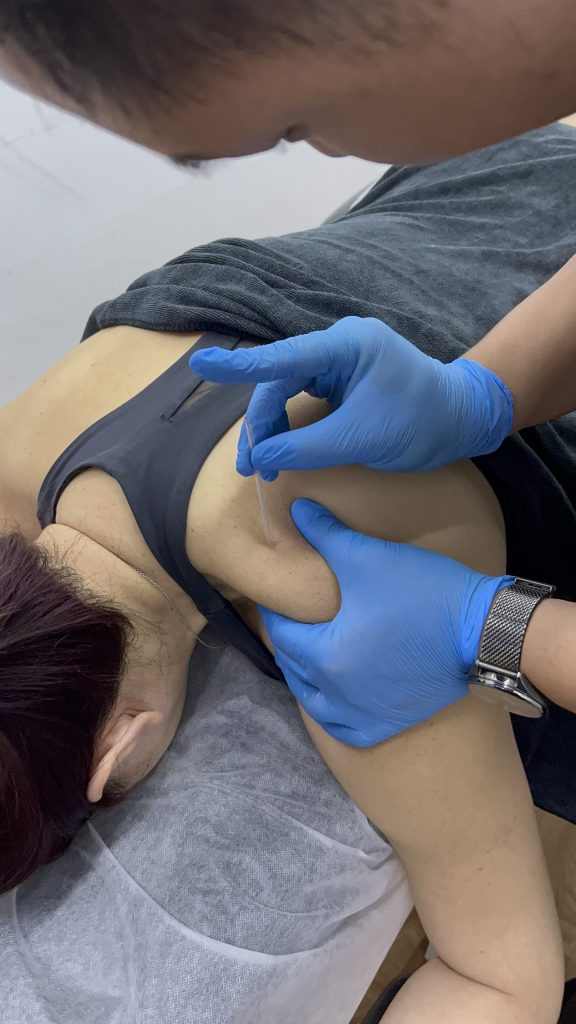
Treatment combined hands-on manual therapy to release the cord-like banding, electrotherapy to help manage pain, and a progressive exercise programme to restore movement and load tolerance. Published clinical reviews describe manual and soft-tissue techniques as a mainstay of care for cording (Yeung et al., 2021).
The plan was staged and re-tested along the way, so progress was judged by measurable movement rather than by how the arm felt on a single day. This objective approach is central to how the team at Elevate Physiotherapy in Singapore manages soft-tissue conditions. No outcome is guaranteed, and individual results vary.
What Was the Outcome — and What Does It Mean for You?
In this case the patient reported meaningful pain relief after the first session and, over four sessions, returned to full gym training. Recovery times differ between individuals, and no outcome can be guaranteed.
The wider takeaway is simple: pain is not always coming from the structure you assume. An accurate, whole-region assessment at Elevate Physiotherapy in Singapore is what identified axillary web syndrome here and directed treatment to the real cause. If arm pain is not settling with treatment aimed at a “strained” muscle, it is worth having the whole region reassessed — our sports injury physiotherapy can help.
Book an Assessment
Arm pain that lingers despite treatment deserves a closer look. If your pain is not settling, an accurate whole-limb assessment at Elevate Physiotherapy in Singapore is a sensible first step.
Frequently Asked Questions
What does axillary web syndrome feel like, and how is it different from a pulled muscle?
Axillary web syndrome feels like a tight, cord-like “string” running from the armpit down the arm, with pain and tightness when you raise the arm. Clinical reviews describe these palpable cords and end-range restriction as the hallmark of cording, whereas a pulled muscle usually produces more localised, contraction-related pain (Yeung et al., 2021). The practical difference is that cording restricts how far the arm can move and often does not respond to treatment aimed at the muscle — which is why persistent, movement-limiting arm pain in Singapore is worth having assessed across the whole limb rather than treated as a simple strain.
How long does it take to recover from cording with physiotherapy?
Recovery varies, but many cases of axillary web syndrome improve over a period of weeks to a few months with appropriate physiotherapy. Observational studies of structured rehabilitation for AWS report resolution over roughly three months and a modest number of sessions on average, though these figures come from post-surgical populations and are general literature, not a promise of results. At Elevate Physiotherapy in Singapore, progress is judged by objective movement milestones rather than a fixed timeline, and no outcome is guaranteed — individual results vary.
Which physiotherapy treatments help with axillary web syndrome in Singapore?
Care for axillary web syndrome typically combines manual and soft-tissue therapy to release the cords, pain-management modalities such as electrotherapy, and a progressive exercise programme to restore movement. Published reviews describe manual and soft-tissue techniques as a mainstay of treatment for cording (Yeung et al., 2021). At Elevate Physiotherapy in Singapore, these are delivered as an individualised plan with objective re-testing, and services such as clinical sports massage and physiotherapy support the hands-on component. The right combination depends on the assessment findings for each person.
Should I see a physiotherapist if my arm pain hasn’t improved with massage?
Yes — arm pain that has not improved with massage or self-treatment is a reasonable reason to see a physiotherapist for a proper assessment. In this case, earlier treatments aimed at an assumed biceps strain gave little relief, and it was a whole-limb assessment that identified the true cause. A physiotherapist in Singapore can assess movement across the shoulder and arm, identify whether cording or another condition is present, and build a plan aimed at the actual source of pain. This is general information and not a substitute for individual medical advice.