


De Quervain’s Tenosynovitis
Pain around the thumb side of the wrist
What Is De Quervain’s Tenosynovitis?
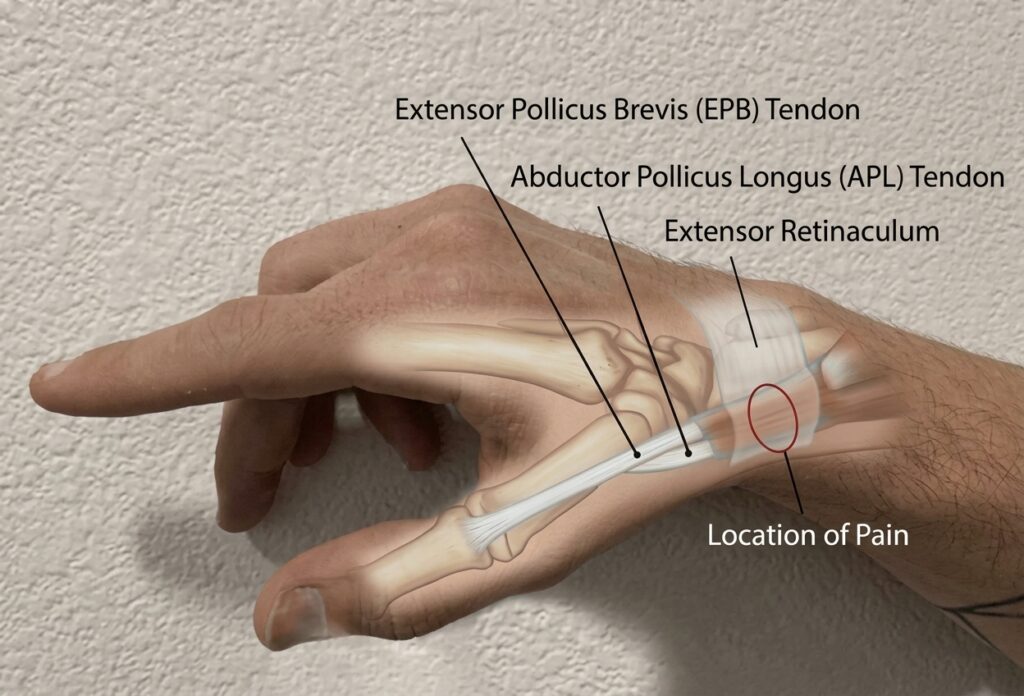
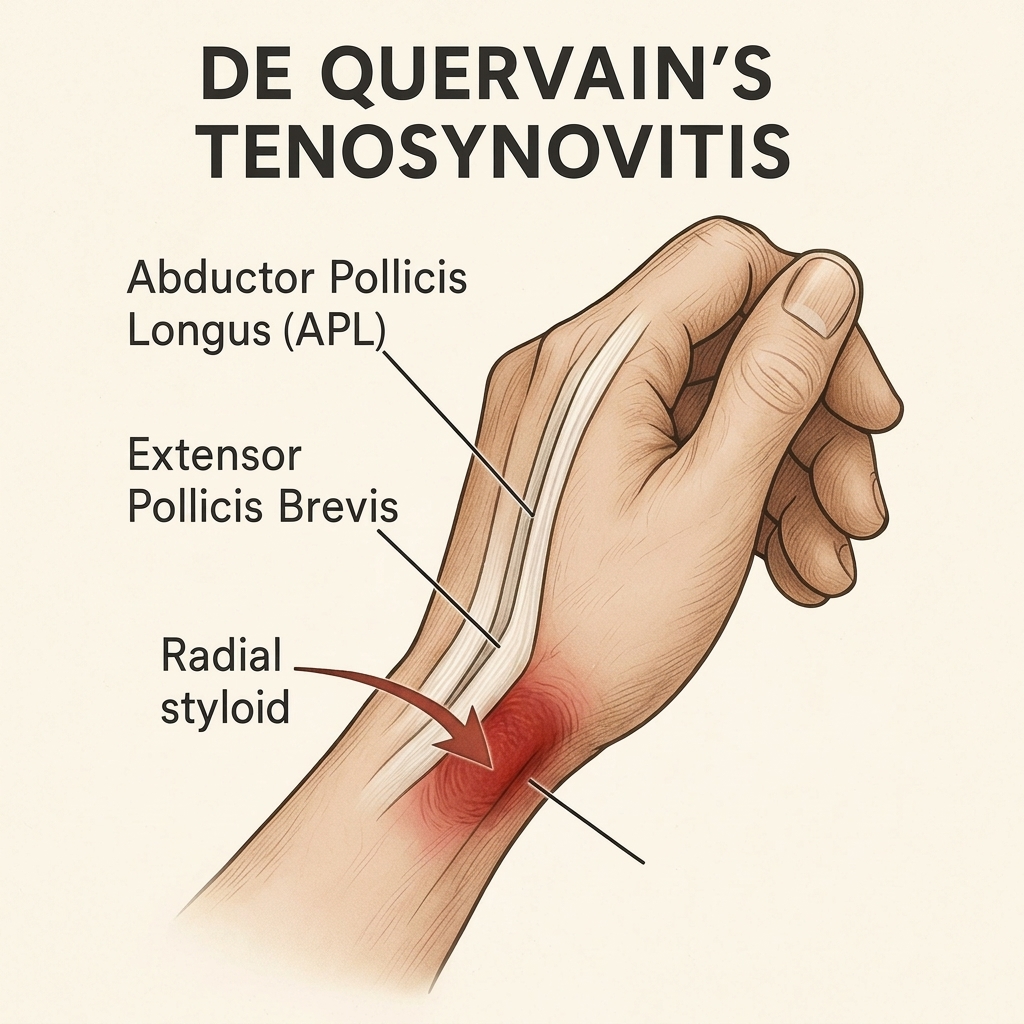
De Quervain’s tenosynovitis affects two tendons that help move the thumb away from the palm:
- Abductor pollicis longus (APL)
- Extensor pollicis brevis (EPB)
These tendons pass through a narrow compartment on the thumb side of the wrist.
When the tissues in this area become painful and irritated, thumb and wrist movements can become uncomfortable.
What Are the Symptoms of De Quervain’s Tenosynovitis?
Typical symptoms include:
- Pain on the thumb side of the wrist
- Pain when gripping
- Pain when lifting a child or object
- Pain when opening jars
- Pain with twisting movements
- Swelling near the base of the thumb
- Reduced grip because of pain
- Pain when moving the thumb
A large population study found De Quervain’s disease in approximately 0.5% of men and 1.3% of women in a working-age population.
What Causes De Quervain’s Tenosynovitis?
It may be associated with:
- Repetitive thumb movements
- Repetitive gripping
- Lifting and carrying
- Repeated wrist deviation
- Changes in hand use
- Pregnancy or postpartum activities
However, it is important not to tell patients that one specific activity necessarily “caused” their condition.
When Should You See a Physiotherapist?
Seek assessment if:
- Thumb-side wrist pain persists
- Gripping becomes painful
- You are struggling with daily activities
- Pain is affecting work or childcare
- Symptoms continue despite reducing aggravating activities
How Is De Quervain’s Tenosynovitis Treated?
At Elevate, we tailor-make a complete “Road Map” based on the patient’s biopsychosocial status, keeping their concerns and goals in mind to help them return to the activities they enjoy most.
Treatment May Include
- Activity modification
- Education
- Temporary thumb or wrist immobilisation, when appropriate
- Gentle movement exercises
- Gradual tendon loading
- Ergonomic changes
- Pain management
Medical treatment may include a corticosteroid injection.
Evidence at a Glance
A 2024 systematic review and meta-analysis of 16 studies involving 1,206 patients found that corticosteroid injection was more successful than immobilisation alone, while combining injection with immobilisation provided additional benefits compared with either approach alone.
Another network meta-analysis found that corticosteroid injection combined with 3–4 weeks of thumb-spica immobilisation ranked highly for short- and mid-term outcomes, although the certainty of the evidence varied.
What Is the Treatment Process Like?
-
Stage 1 – Reduce Aggravating Load
Modify painful gripping, lifting and thumb movements.
-
Stage 2 – Settle Symptoms
Appropriate support or splinting and symptom management.
-
Stage 3 – Restore Movement
Gradually restore comfortable thumb and wrist movement.
-
Stage 4 – Strengthen
Progressively reload the thumb and wrist.
-
Stage 5 – Return to Normal Activities
Gradually reintroduce lifting, gripping and occupational tasks.
How Long Does Recovery Take?
Many people improve over several weeks to a few months.
Recovery depends on how long symptoms have been present, the severity of the condition and whether treatment such as an injection is required.
Persistent symptoms despite appropriate conservative treatment may require specialist review.
Evidence at a Glance
De Quervain’s disease has been reported in approximately 0.5% of men and 1.3% of women in one population study.
A 2024 meta-analysis involving 1,206 patients found corticosteroid injection more effective than immobilisation alone, with additional benefit when the two were combined.
The Good News Is
Most patients can return to comfortable hand use when the irritated tissues are given enough time to settle and loading is then gradually rebuilt.
Recovery Pathway
Reduce Painful Load → Settle Symptoms → Restore Movement → Gradually Strengthen → Return to Function
This information is for general education and does not replace an individual clinical assessment.