


When a finger catches, clicks or locks during movement
What Is Trigger Finger?
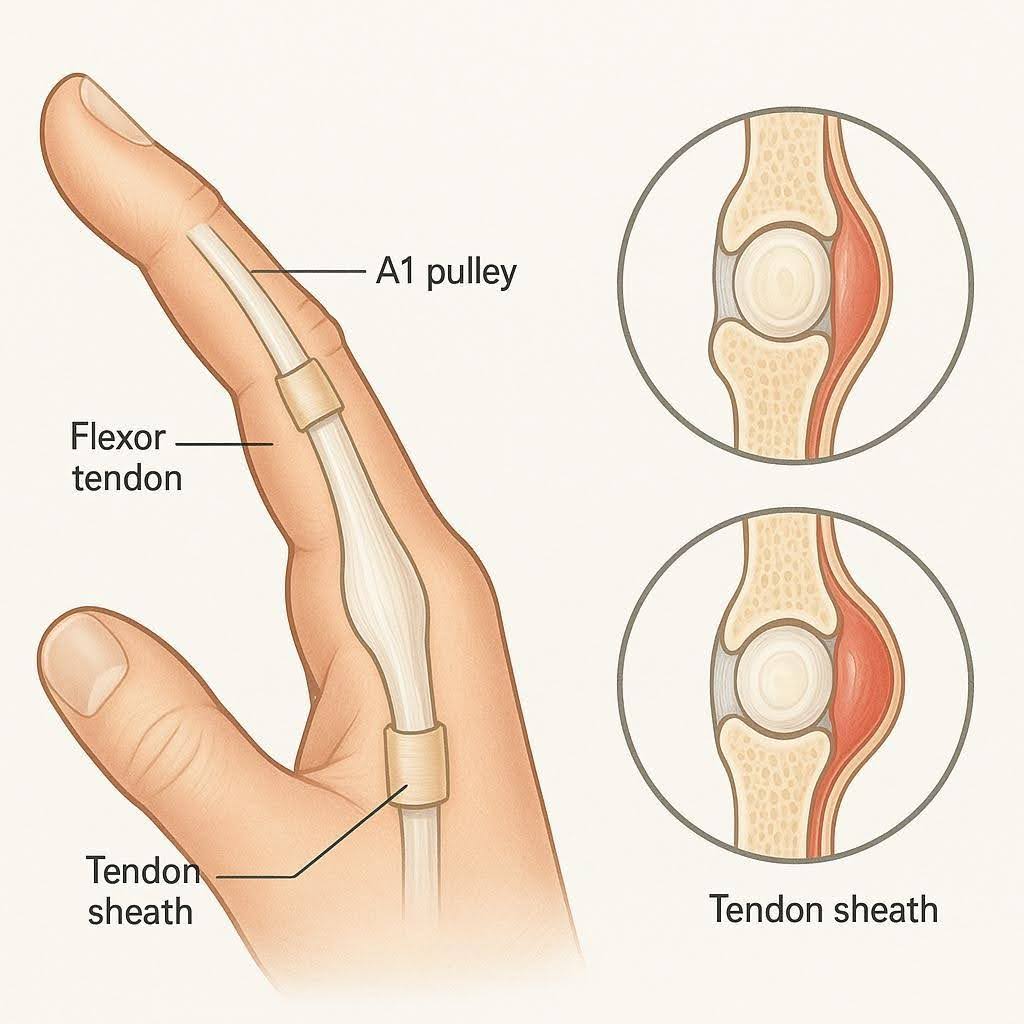
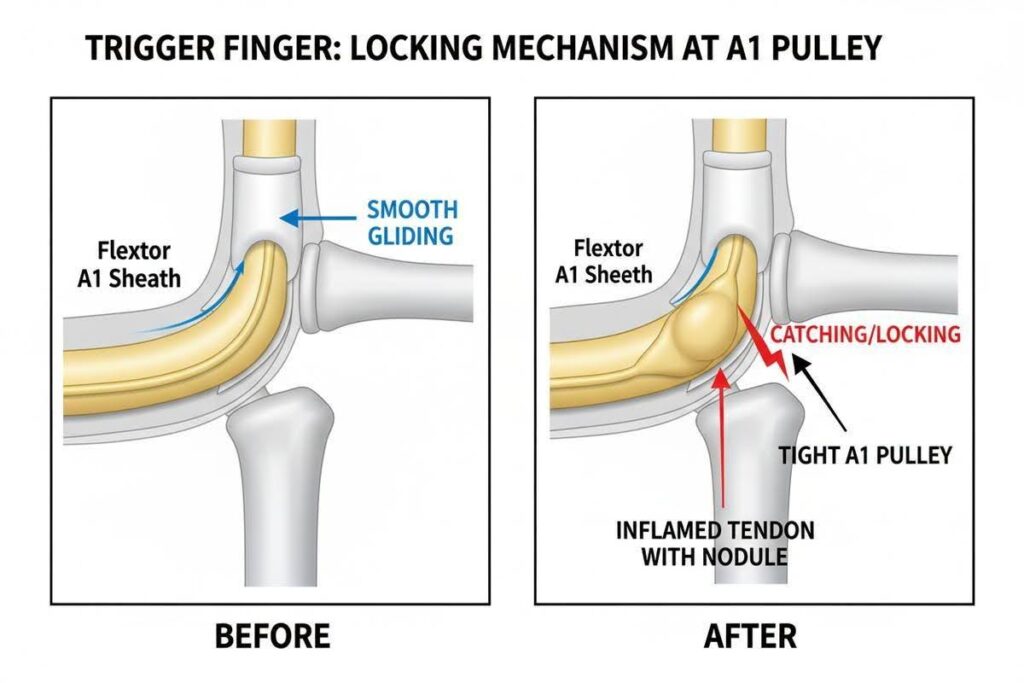
Trigger finger, also called stenosing tenosynovitis, occurs when the flexor tendon has difficulty gliding smoothly through a pulley at the base of the finger.
Instead of moving smoothly, the tendon can become irritated or enlarged and may catch as the finger bends and straightens.
This can create the characteristic clicking, catching or locking sensation.
A large contemporary population study found trigger finger in approximately 2% of the general population and 5.8% of people with diabetes.
What Are the Symptoms of Trigger Finger?
You may experience:
- Pain at the base of the finger or thumb
- Clicking or catching
- Finger stiffness
- Difficulty straightening the finger
- A finger that temporarily locks in a bent position
- Symptoms that are worse in the morning
- Tenderness over the A1 pulley
- In more severe cases, the finger may need the other hand to straighten it
What Causes Trigger Finger?
The exact cause is not always clear.
Risk is associated with:
- Repetitive gripping
- Repeated hand use
- Diabetes
- Certain systemic conditions
- Previous hand problems
Importantly, trigger finger is not simply caused by “overuse.”
When Should You See a Physiotherapist?
Consider assessment if:
- Clicking or catching persists
- Finger movement becomes painful
- Morning stiffness is increasing
- The finger starts locking
- You are avoiding activities because of the problem
- You have diabetes and develop persistent finger symptoms
How Is Trigger Finger Treated?
At Elevate, we tailor-make a complete “Road Map” based on the patient’s biopsychosocial status, keeping their concerns and goals in mind to help them return to the activities they enjoy most.
Treatment depends on the severity and duration of symptoms.
Conservative Treatment
Conservative treatment may include:
- Activity modification
- Reducing forceful or repetitive gripping
- Splinting in selected cases
- Gentle range-of-motion exercises
- Hand therapy
- Pain management
Medical treatment may include a corticosteroid injection, particularly when symptoms persist.
Evidence at a Glance
A 2022 meta-analysis of randomised trials found that corticosteroid injection produced a pooled treatment success rate of approximately 64%, compared with approximately 28% in control groups.
More recent evidence also suggests that corticosteroid injection effectiveness varies with the steroid used and patient characteristics.
What Is the Treatment Process Like?
-
Stage 1 – Reduce Irritation
Reduce activities involving forceful, repetitive gripping.
-
Stage 2 – Restore Smooth Movement
Gentle finger mobility and appropriate hand therapy.
-
Stage 3 – Splinting if Appropriate
Selected patients may benefit from temporary splinting.
-
Stage 4 – Medical Management if Required
An injection may be considered.
-
Stage 5 – Surgery if Persistent
Surgical release can be considered when conservative management fails.
How Long Does Recovery Take?
Some people improve over weeks to a few months with conservative management.
Symptoms that have been present for a long time or involve significant locking may take longer.
If surgery is required, many patients return to normal activities within several weeks, although tenderness and scar sensitivity can take longer to settle.
Evidence at a Glance
A 2026 population-based analysis involving more than 465,000 patients estimated trigger finger prevalence at 2.0% overall and 5.8% among people with diabetes.
Evidence supports corticosteroid injection as an effective treatment for many patients, but recurrence and the need for further treatment can occur.
The Good News Is
Trigger finger is usually very manageable. Early treatment can help prevent the finger from becoming increasingly stiff or locked.
Recovery Pathway
Reduce Irritation → Improve Tendon Movement → Restore Finger Mobility → Return to Gripping and Function
This information is for general education and does not replace an individual clinical assessment.