

Pain and reduced tolerance of the tendons on the outside of the hip
What is Gluteal Tendinopathy?
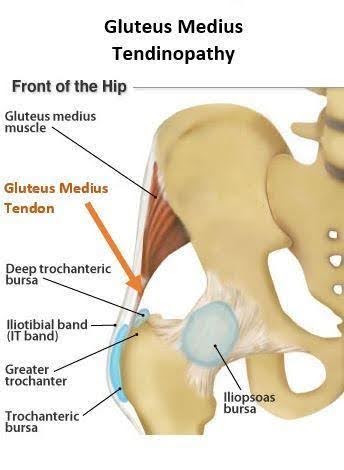
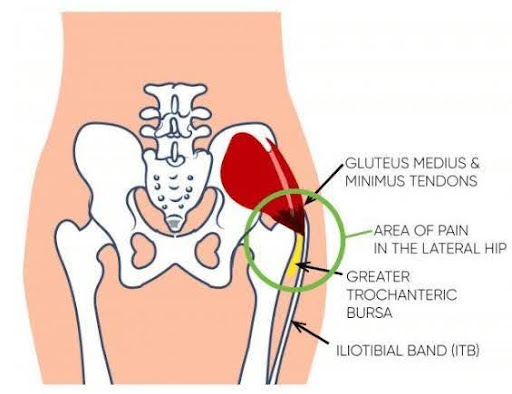
Gluteal tendinopathy is a condition affecting the tendons of the gluteus medius and gluteus minimus muscles, which attach to the outside of the hip.
These muscles help to:
- Stabilise the pelvis
- Control the hip when walking
- Keep the pelvis level when standing on one leg
- Support activities such as walking, climbing stairs and running
When the tendon is exposed to more load or compression than it can currently tolerate, it can become painful.
You may also hear the term Greater Trochanteric Pain Syndrome (GTPS). This describes pain around the outside of the hip and may involve the gluteal tendons and surrounding tissues.
Common Symptoms of Gluteal Tendinopathy
- Pain on the outside of the hip
- Pain when lying on the affected side
- Pain when climbing stairs
- Pain during prolonged walking
- Pain when standing on one leg
- Difficulty getting up from a low chair
- Pain when crossing the legs
- Pain after prolonged sitting
- Tenderness around the bony area on the outside of the hip
Pain may sometimes travel down the outer thigh.
What causes it?
Gluteal tendinopathy is usually related to load and compression on the tendon.
Contributing Factors May Include
- Sudden increase in walking or running
- Hill walking or running
- Weakness or reduced capacity of the hip muscles
- Prolonged standing on one leg
- Sleeping directly on the painful side
- Crossing the legs frequently
- Changes in physical activity
- Age-related changes in tendon capacity
It is important not to assume that weakness or “poor alignment” is the only cause.
When Should You See a Physiotherapist?
You should consider seeing a physiotherapist if:
- Hip or groin pain lasts for more than a few weeks.
- Pain interferes with walking or exercise.
- Sitting for long periods causes pain.
- You experience repeated clicking or catching in the hip.
- You have difficulty getting in and out of a car.
- Squatting has become painful.
- You are avoiding activities because of hip pain.
- Your hip feels weak or unstable.
- Your symptoms are getting progressively worse.
A physiotherapist can assess your hip movement, muscle strength, movement patterns and functional limitations.
Importantly, not all groin or hip pain is caused by a labral tear. Other conditions can produce very similar symptoms, so a proper assessment is important.
If symptoms are severe, persistent or associated with significant trauma, your doctor may recommend imaging such as X-rays or MRI/MR arthrography.
How is it treated?
At Elevate, we tailor-make a complete “Road Map” based on the patient’s biopsychosocial status, keeping their concerns and goals in mind to help them return to the activities they enjoy most.
Treatment Commonly Focuses On
- Education about tendon loading
- Reducing excessive compression of the tendon
- Modifying painful activities
- Progressive hip strengthening
- Gluteal strengthening
- Balance and single-leg control
- Gradual return to walking, running or sport
Exercises May Include
Progressively loaded exercises may include:
- Hip abduction
- Bridges
- Sit-to-stand
- Step-ups
- Single-leg exercises
The aim is not simply to rest the tendon, but to gradually improve its capacity.
A 2025 systematic review found moderate-strength evidence supporting exercise plus education as a core treatment, with beneficial effects on pain and function.
Process/Stages of Gluteal Tendinopathy Rehabilitation
-
Stage 1 – Reduce Compression
Modify positions such as prolonged side-lying and excessive leg crossing.
-
Stage 2 – Settle Symptoms
Maintain comfortable movement while avoiding excessive aggravation.
-
Stage 3 – Build Hip Strength
Progressively load the gluteal muscles.
-
Stage 4 – Improve Functional Control
Introduce stairs, single-leg activities and walking challenges.
-
Stage 5 – Return to Activity
Gradually increase walking, running or sporting activities.
How long does recovery take?
Improvement commonly takes several weeks to several months.
Long-standing tendinopathy can take longer because the tendon needs time to rebuild its capacity.
Consistency with progressive strengthening is more important than trying to completely avoid activity.
Evidence at a Glance
In the landmark LEAP trial, 204 people with gluteal tendinopathy were compared across education and exercise, corticosteroid injection, and wait-and-see groups. Education plus exercise produced better overall improvement than both comparison approaches at 8 weeks and better global improvement than injection at 52 weeks.
A 2023 review describes greater trochanteric pain syndrome (GTPS) and gluteal tendinopathy as particularly common in women over 50, with one review citing approximately 1 in 4 women over 50 affected.
The Good News Is
Gluteal tendinopathy is usually manageable. The goal is not lifelong avoidance of activity—it is to gradually teach the tendon to tolerate the activities you enjoy.
Recovery Pathway
Reduce Excessive Compression → Settle Symptoms → Strengthen → Improve Hip Control → Return to Activity
This information is for general education and does not replace an individual clinical assessment.