

Delayed Onset Muscle Soreness (DOMS): Causes and Recovery
Quick Answer: Delayed onset muscle soreness is the stiffness and tenderness that appears roughly a day after unfamiliar or heavy exercise, peaks at 24 to 48 hours, and settles within about a week. It is caused by microscopic damage and the repair response that follows, not by lactic acid, and gentle movement helps more than complete rest.
You feel fine walking out of the gym. The next morning, sitting down on a chair takes planning, and by day two the stairs at the MRT station have opinions about your quadriceps.
That delay is the defining feature, and it is also why so many people in 2026 assume they have injured something. This guide from Elevate Physiotherapy explains what delayed onset muscle soreness actually is, how to tell it apart from a muscle strain, how long it lasts, and what the current evidence says about the recovery methods people reach for in Singapore.
What is delayed onset muscle soreness?
Delayed onset muscle soreness, usually shortened to DOMS, is muscle pain and stiffness that develops several hours after exercise rather than during it. It typically appears within 12 to 24 hours, peaks around 24 to 48 hours, and resolves over the following few days.
The soreness is diffuse rather than pinpoint, affects the muscles you worked rather than a single spot, and is usually felt on both sides if you trained both sides. Muscles are tender to press, stiff at the start of a movement, and temporarily weaker than usual.
It follows unfamiliar work far more than hard work. A first session back after a break, a new exercise, a longer run than usual, or a session with more downhill or lowering work will all produce it, even at a moderate intensity.
It is a normal training response, not a condition requiring treatment. Where it matters clinically at Elevate Physiotherapy in Singapore is when someone cannot tell whether what they are feeling is ordinary soreness or an actual injury, and stops training altogether as a result.
Why are my muscles sore one to two days after exercise?
Muscles are sore a day or two after exercise because of microscopic damage to muscle fibres and the connective tissue around them, followed by the inflammatory and remodelling response that repairs it. That repair process sensitises the tissue, which is why the soreness arrives late rather than immediately.
Lengthening contractions do most of the damage. Lowering a weight under control, running downhill, and the landing phase of jumping all load the muscle while it is being stretched, and that combination produces far more soreness than the shortening half of the same movement.
Lactic acid is not the explanation, despite how durable the myth is. Lactate produced during exercise clears from the blood within roughly an hour of finishing, long before the soreness has even started.
DOMS OR AN INJURY? HOW THE TWO USUALLY DIFFER
|
Delayed onset muscle soreness |
Muscle strain |
|
|
When it starts |
Hours later, often overnight |
Instantly, at an identifiable moment |
|
Where it is felt |
Spread through the muscle group, usually both sides |
One spot you can point to with a finger |
|
What it feels like |
Dull ache and stiffness, tender to press |
Sharp catch at the time, sometimes a pop |
|
Effect of gentle movement |
Eases after a few minutes of moving |
Stays sore or worsens with load |
|
Direction of travel |
Improves each day from day two or three |
Does not improve, or improves then relapses |
Soreness that stays severe beyond a week, marked swelling in one limb, or dark cola-coloured urine after a very hard session all need medical review rather than a physiotherapy appointment. The sports injury team at Elevate Physiotherapy in Singapore will redirect anyone presenting that way.
How long does DOMS last?
Delayed onset muscle soreness usually peaks 24 to 48 hours after the session and settles substantially by 72 hours, with the last of it gone within about five to seven days. Strength and power take a similar course, dipping in the first day or two and returning as the soreness fades.
The single most reassuring thing about it is how quickly it stops happening. Repeat the same session a week or two later and the soreness is markedly less, because the muscle adapts to that specific pattern of loading after one exposure.
That has a practical consequence for anyone restarting training in Singapore. The soreness after a first session back is not a signal that the programme is too hard — it is a signal the movement is unfamiliar, and it will not repeat at the same intensity.
A typical DOMS timeline:
- 0–12 hours — little or no soreness. Most people finish the session feeling fine.
- 12–24 hours — stiffness sets in, usually noticed first thing the next morning.
- 24–48 hours — the peak. Tenderness on pressing, reduced range, temporary loss of strength.
- 48–72 hours — clearly easing. Movement is more comfortable and strength is returning.
- 3–7 days — resolved. Anything still severe past this point is worth having assessed at Elevate Physiotherapy in Singapore.
What helps you recover from DOMS?
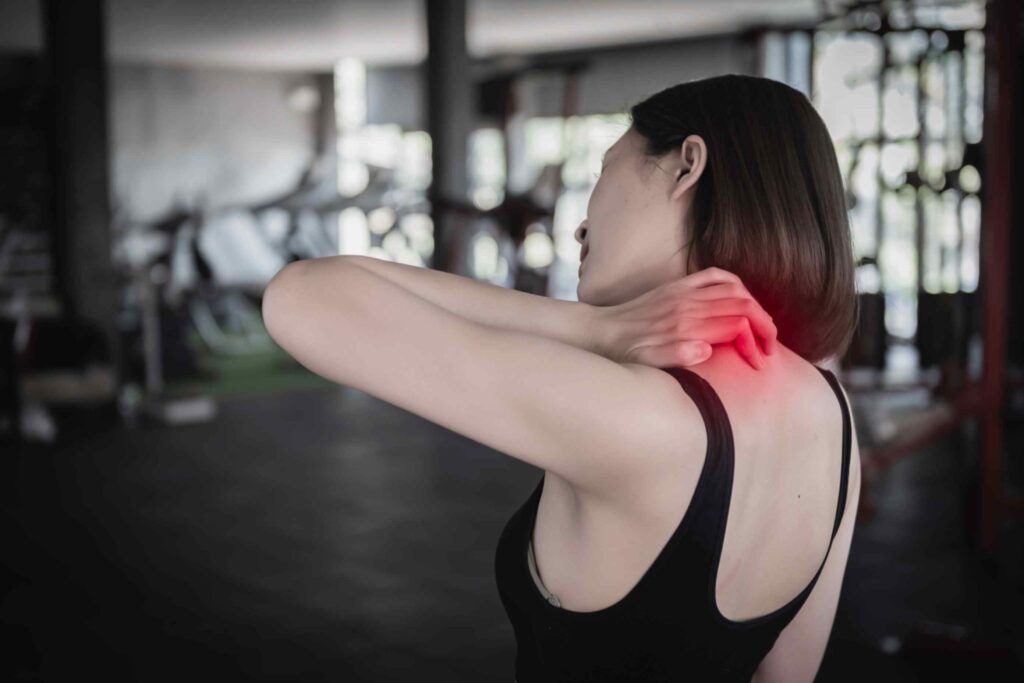
Light movement is the most reliable thing for delayed onset muscle soreness, with massage and cold-water immersion showing short-term benefits in the research. The honest position is that no recovery method shortens the underlying repair process — they change how sore you feel while it happens.
“Many people think pain means they should stop moving and rest completely,” says Winsen Citra, Principal Physiotherapist at Elevate Physiotherapy. “In most musculoskeletal cases the opposite is true — the right graded movement, loaded correctly, is what actually restores the tissue. Rest has a place early on, but recovery is built on progressive loading, not avoidance.”
A network meta-analysis of 22 randomised controlled trials, published in May 2026 in the journal Healthcare, compared the common post-exercise recovery methods. Massage produced the largest reduction in soreness at 24 hours (SMD −2.616, 95% CI −4.427 to −0.804) and ranked highest of all methods for soreness, while active recovery ranked highest for restoring jump performance (SMD 0.944, 95% CI 0.201 to 1.686).
The same analysis is equally clear about the limits. By 48 hours only cold-water immersion still showed a significant effect on soreness (SMD −1.568, 95% CI −2.578 to −0.558), and the massage benefit had gone. Sports massage in Singapore at Elevate Physiotherapy is therefore offered as short-term symptom relief through a heavy training block, not as something that speeds up muscle repair.
Disclaimer: This article is for informational purposes only. Please consult a qualified healthcare professional. Individual results vary and no treatment outcome is guaranteed.
Frequently asked questions
How do I know if it is DOMS or an actual muscle injury?
Timing and location separate the two more reliably than severity does. Delayed onset muscle soreness starts hours after the session, is spread through a whole muscle group, usually affects both sides, and eases after a few minutes of gentle movement.
A muscle strain announces itself at a specific moment during the session, sits in one spot you can point to, and does not ease with movement — it tends to sharpen under load. If soreness is one-sided, started suddenly, or is still severe after a week, have it assessed at Elevate Physiotherapy in Singapore rather than training through it.
Does sports massage help with muscle soreness after exercise?
Massage does reduce soreness in the first day, though the effect does not last.
A network meta-analysis of 22 randomised controlled trials published in May 2026 in Healthcare found massage produced the largest reduction in soreness at 24 hours (SMD −2.616, 95% CI −4.427 to −0.804) and ranked highest among the methods compared for soreness ratings. By 48 hours, however, only cold-water immersion still showed a significant effect. That makes sports massage in Singapore a reasonable option for comfort during a heavy training block, and Elevate Physiotherapy positions it that way rather than as a treatment that accelerates muscle repair.
Should I train again while my muscles are still sore from DOMS?
Lorem ipsum dolor sit amet, consectetuer adipiscing elit, sed diam nonummy nibh euismod tincidunt ut laoreet dolore magna aliquam erat volutpat.
Why do I get DOMS every time I go back to the gym in Singapore?
Recurring soreness after every return to the gym almost always means the gaps between training blocks are long enough for the muscle to lose its adaptation to that pattern of loading.
Muscles adapt to a specific movement after a single exposure, which is why the second session of a new programme produces far less soreness than the first — but that protection fades over weeks away. Training more consistently at a lower intensity produces far less soreness than training hard intermittently. Elevate Physiotherapy in Singapore works with people returning to exercise to set a starting load that does not leave them too sore to come back.
Delayed onset muscle soreness is uncomfortable, predictable and short-lived, and it is not a reason to abandon a programme. Knowing how it differs from an injury is what stops a normal training response from turning into weeks of avoidance. If you are unsure whether what you are feeling is soreness or something that needs looking at, book an assessment with Elevate Physiotherapy at Maju Avenue or Jalan Besar, or arrange a home visit anywhere in Singapore.

Written by
Winsen Citra
Principal Physiotherapist
Winsen is the Principal Physiotherapist at Elevate Physiotherapy, Singapore. A University of Melbourne physiotherapy graduate and former Singapore General Hospital physiotherapist, he specialises in sports and musculoskeletal rehabilitation and works with athletes and active individuals to recover from injury and return to full performance.